About the study
Massey University’s EpiCentre studies infectious diseases in livestock.
This study aimed to help farmers manage the risk of salmonellosis on their farms, thus protecting animal welfare and preventing the significant production impacts and costs associated with salmonella outbreaks and risk’s to public health.
A better understanding of salmonella in dairy cattle will lead to improved prevention and control of outbreaks and better outcomes for public health in New Zealand by protecting farm workers, their families and the general public from salmonellosis.
Project team
The project lead for this study is Dr Chris Compton.
Dr Chris Compton
PhD, MVS, BVSc., AFHEA
Senior Lecturer in Veterinary Epidemiology
Simon Verschaffelt
Technician
Salmonella in New Zealand
Salmonella causes outbreaks of scouring, abortion and death in dairy cattle. The effects of salmonella on-farm can be devastating, posing serious risk to health, productivity and welfare of affected animals. Salmonella are also a leading cause of food poisoning in humans in New Zealand.
The prevalence of Salmonella outbreaks on New Zealand dairy farms has increased in the years from 2015 to 2020 , and new serotypes emerged and spread around the country. The same trend is observed in food-borne salmonellosis in humans.
Ongoing national surveillance of veterinary diagnostics laboratory in the years 2015 – 2020 shows the emergence and rapid spread of Salmonella serotypes Bovismorbificans, Give and Brandenburg in the cattle population of New Zealand (Figure 1).
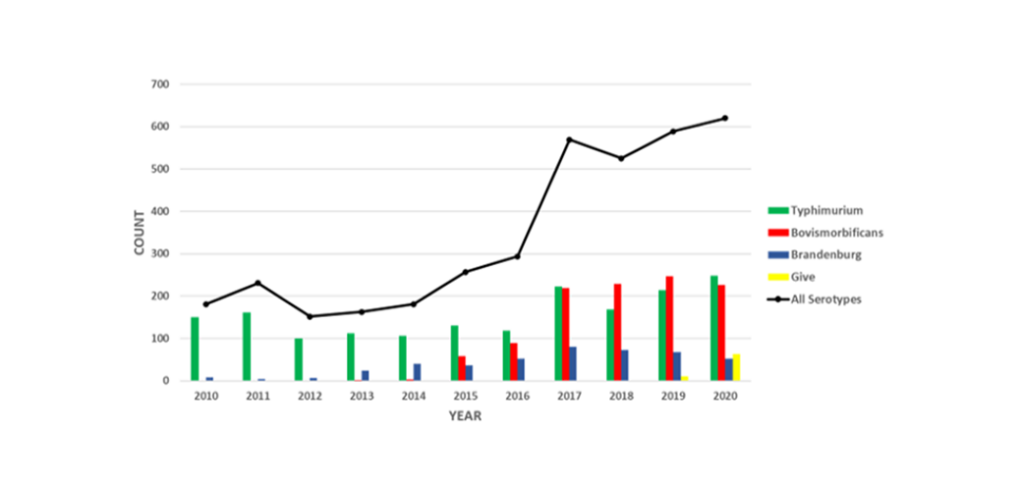
Salmonella trends 2010 to 2020
Figure 1: Laboratory confirmed cases of salmonella in cattle since 2010 (source: MPI)
Foodborne disease surveillance conducted by ESR shows a mirroring trend in the number of diagnosed human cases of Salmonella Bovismorbificans (Figure 2).
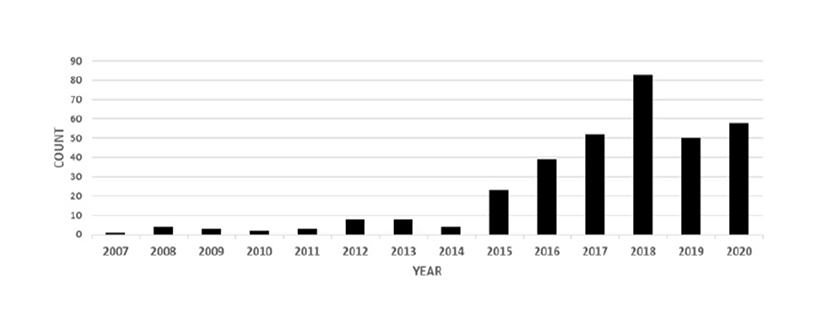
Count of human bovismorbificans cases
Figure 2: Notified human cases of Salmonella Bovismorbificans since 2007 (source: MPI/ESR)
Key results and recommendations for farmers from a National Study of Salmonellosis on NZ Dairy Farms
Chris Compton, EpiCentre, School of Veterinary Science, Massey University
Background
NZ veterinary diagnostic laboratories reported a two- to three-fold increase in confirmed cases of salmonellosis on dairy farms between 2011 and 2021, and the emergence of Salmonella serovars previously undetected in NZ. These patterns concerned the Ministry for Primary Industries (MPI) because of the impact of these cases on the welfare and productivity of dairy cattle, and the potential increased risk to public health from this zoonotic disease. MPI requested Massey University to undertake a nationwide study in the dairy seasons starting in 2021 and 2022 to describe the extent of salmonellosis outbreaks on dairy farms and to recommend control measures against them to farmers.
How the study was run
Dairy vets and vet diagnostic labs helped us register 107 farmers on-line for the study whose animals had experienced one or more lab-confirmed cases of salmonellosis that were not Brandenburg serovar during the study. From these, we enrolled 53 ‘case’ farms with 10 or more animals affected and, with the help of the Fonterra On Farm Excellence (OFE) Operations Team, a further 118 unaffected ‘control’ farms were enrolled as a comparison group. All farms had spring- or split autumn-spring calving patterns and supplied a milk processor. Each eligible farmer provided further information about their farms and management practices by telephone interview with the researchers.
Key study results
- Dairy farmers that experienced salmonellosis outbreaks most frequently reported diarrhoea (scours) among groups of mixed age (MA) milking cows (60% of farms), milk-fed calves (36% of farms) and scours or abortion in dry cows (34 % of farms) and less frequently among rising 2-year-old (R2) heifers (17 % of farms)
- On farms where scours outbreaks involved mixed age milking cows, typically 4-10% of cows were affected and 0.4-3% of cows died, whereas when scours affected calves, typically 20-50% of calves were affected and 2-20% died
- Although calf-rearing farms were not eligible for the study and not included in other analyses, several self-registered calf-rearers reported that typically 30-100% of the calves were affected and 2-20% died
- Approximately one quarter of case farms experienced salmonellosis outbreaks in multiple management groups in the same dairy season
- 13% of farmers on control farms reported a diagnosis of salmonellosis in the previous 5-years, compared with 21% of case farmers in the same period
- Half of the case farm farmers used a Salmonella vaccine on their R2 heifers and MA cows in the event of an outbreak and 6% of the control farms had a preventive vaccination programme
We identified by use of statistical analyses the following risk factors for salmonellosis outbreaks in different management groups:
- In any cattle management group:
- Greater herd size- 30% increased risk per 100 cow greater herd size
- Dairy effluent application rate- increased risk 3.3 times if rate > 15mm compared with =< 15mm
- Presence of feral deer on their farm- increased risk 5.1 times if feral deer reported seen on the farm
- In milking cows only:
- Use of feeds including pre-mixed magnesium- increased risk 5 times compared with no feeds including pre-mixed magnesium
- In pre-weaned calves only:
- Greater herd size- 50% increased risk per 100 cow greater herd size
- Greater number of calf rearing staff- 2 times increased risk per additional person
Recommendations to control salmonellosis on NZ dairy farms
- Biosecurity practices
- Farms of above average herd size and multiple calf-rearing staff should implement strict biosecurity measures to prevent salmonellosis outbreaks on their farm, particularly measures that target protection of calves, and when salmonellosis is first diagnosed in a season
- Greater number of calf rearing staff- 2 times increased risk per additional person
- Feed and effluent management practices
- Check the management of magnesium supplementation for milking cows to ensure that dosage rates are not excessive, particularly if using a feed blend that includes magnesium
- Check dairy effluent management is best-practice, and if application rates exceed 15 mm, consider ways to reduce this rate
- Public health measures
- Because salmonellosis can affect humans, the health of farm staff and families need to be protected when salmonellosis is diagnosed on the farm, apply good hygiene practices, use clean personal protective equipment and switch to shop-bought milk if currently drinking raw milk from the herd
To explore effective biosecurity measures for controlling salmonellosis on New Zealand dairy farms.
Contact us : : Salmonella study
Email @ salmonella@massey.ac.nz
Postal address @
EpiCentre PN623
Massey University
Private Bag 11-222
Palmerston North 4442
New Zealand