
Over the 2025-2026 summer period, Lisa Martin (Ngāti Pikiao, Ngāpuhi
Nui Tonu, Te Maru o Ruahine Trust) undertook a dendroecology or tree-ring study together with Andrew Wells (Wildlands Consultants), Utiku Potaka (Ngāti Hauiti, Ngāti
Apa, Whakauae Research) and Callum Rees (Massey University).
The aim of the study was to build a record of environmental change over time from native trees to better understand how the landscape has formed over time and what impact landslides have had around Pūtōrino.
The first step was to map remnant native vegetation across the study area using historic aerial imagery and ground truthing. This mapping was then used to target field work carried out between the 23rd and 27th of Nov 2025. A total of 59 cores were taken from a range of native trees, including Totara, Matai, Kahikatea, Rimu, Kanuka, Ngaio and Rewarewa. Six slabs were taken from stumps and logs that date back to when the area was first cleared.
The cores were taken using a range of Swedish-made Haglof Increment Borers that take a pencil-sized core from the trunk of a living tree. Extracting a core wounds the tree. However, trees respond to the borer hole as they would any other wound, isolating the injured tissue through compartmentalisation to resist the spread of pathogens. This means risk to tree health is low and can be minimised by using a clean, sharp increment borer and angling the borer slightly upwards to prevent water and dirt from running into the hole. Our native trees can be hundreds and, in some cases, thousands of years old, providing an important window into the past.
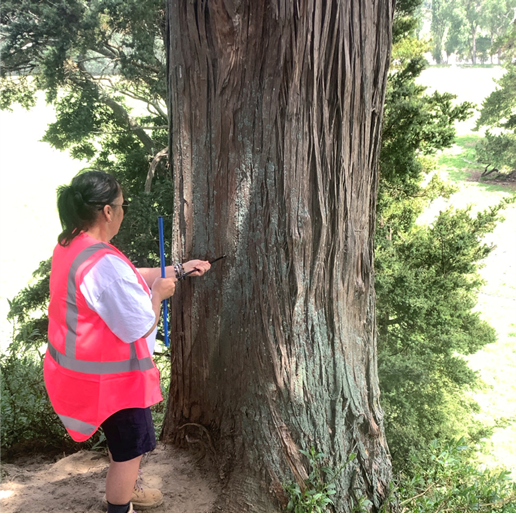
Lisa Martin starting a core on a Totara tree using a 500 mm long Haglof Increment Borer
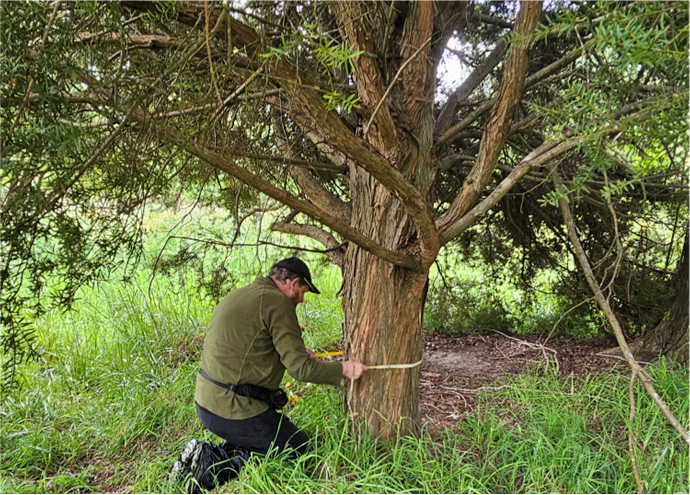
Andrew Wells measuring the diameter of a 70-year-old totara tree that had become partly buried in flood sediment adjacent to the Rangitīkei River.
Once the cores were taken, they were glued into pre-made MDF boards with 5 mm grooves cut into them. Careful attention was paid to mark the bark and centre of each core together with the sample number. Tape was applied to ensure a tight fit while the PVA glue set. Once the cores had dried they were brought to Massey University for sample prepartion. The MDF board provides a level surface from which to start sanding into the core, beginning at coarse grit (60) and incrementally going finer up to 200 grit. Once sanding was complete, a binocular microscope was used to start counting the rings and filling the data out in a spreadsheet.
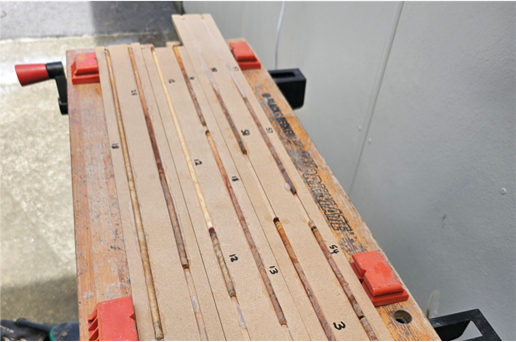
Dry cores mounted onto MDF board ready for sanding.
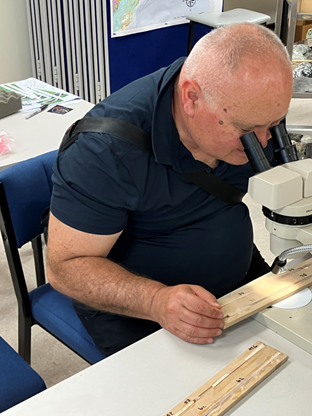
Utiku Potaka counting tree rings on finished cores
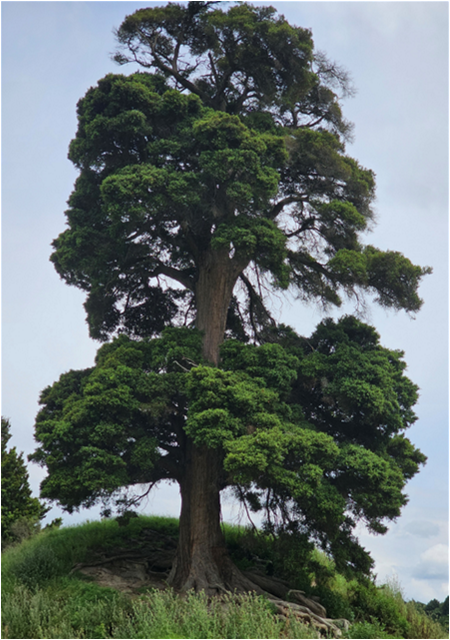
A large totara tree in the study area was found to be close to 300 years old.
To learn more about the key findings from this report, come along to the next wānanga being held at Rātā Marae on the 23rd May 2026.