
International Sedimentological Congress Field Trip Showcases Geology and Cultural Connections in Ngāti Hauiti Rohe
On 22–23 January 2026, researchers and industry professionals from around the world participated in a pre-conference field trip associated with the International Sedimentological Congress entitled Distal Sedimentation from Large-Volume Silicic Eruptions in a Regression-Dominated Marine Environment. The field trip showcased the internationally significant geology of the Pūtōrino e Rua study area and the wider Ngāti Hauiti rohe, while also highlighting the deep cultural connections that exist between people and place.
The first day began at Waitapu Stream, where participants explored an exceptional exposure of a ~100 m thick cyclothem representing shallow marine deposition approximately 900,000 years ago. The section contains the first occurrence of the Kaukatea Pumice in the Whanganui Basin stratigraphy, providing important insights into the timing and impacts of large silicic volcanic eruptions on marine sedimentation.
A major highlight of the trip was the visit to Rātā Marae, where participants were welcomed with a pōwhiri and hosted for lunch. Utiku Potaka shared the history of the area and explained the special relationships Ngāti Hauiti have with the landscapes and sites visited during the field trip. For many international visitors, this was a unique opportunity to gain an understanding of Māori culture and its interconnections with the environment and geology.
Following the marae visit, the group travelled to Otara Bridge to examine the Tuhua Shell Bed. Thanks to the efforts of Jack Baker, who had cut a path and constructed a stile to allow safe access across a seven-wire fence, participants were able to visit this important site. Here, they observed evidence of Zygochlamys delicatula, a cool water scallop species that migrated into the Whanganui Basin around 2.4 million years ago. Its arrival provides some of the earliest evidence in New Zealand for the onset of major Northern Hemisphere glaciations and the expansion of large continental ice sheets.
After an evening at Makoura Lodge, the field trip continued with visits to Table Flat, the Oroua Valley Lookout, and the Manawatū Saddle. These sites provided spectacular views of the basin sedimentary record, including evidence of a large fan delta. Together, the field localities illustrated how tectonics, sea-level change, climate, and volcanism have interacted to shape the evolution of the Whanganui Basin through time.
The field trip brought together participants from New Zealand, China, Japan, Poland, South Korea, Saudi Arabia, and elsewhere, fostering international collaboration and knowledge exchange. By combining world-class geological exposures with the stories and perspectives of mana whenua, the excursion provided a memorable and uniquely Aotearoa experience for all involved.
The success of the trip demonstrates the international significance of the Pūtōrino e Rua study area, not only as a natural laboratory for understanding Earth’s history, but also as a place where geological and cultural narratives can be shared together to enrich scientific understanding.
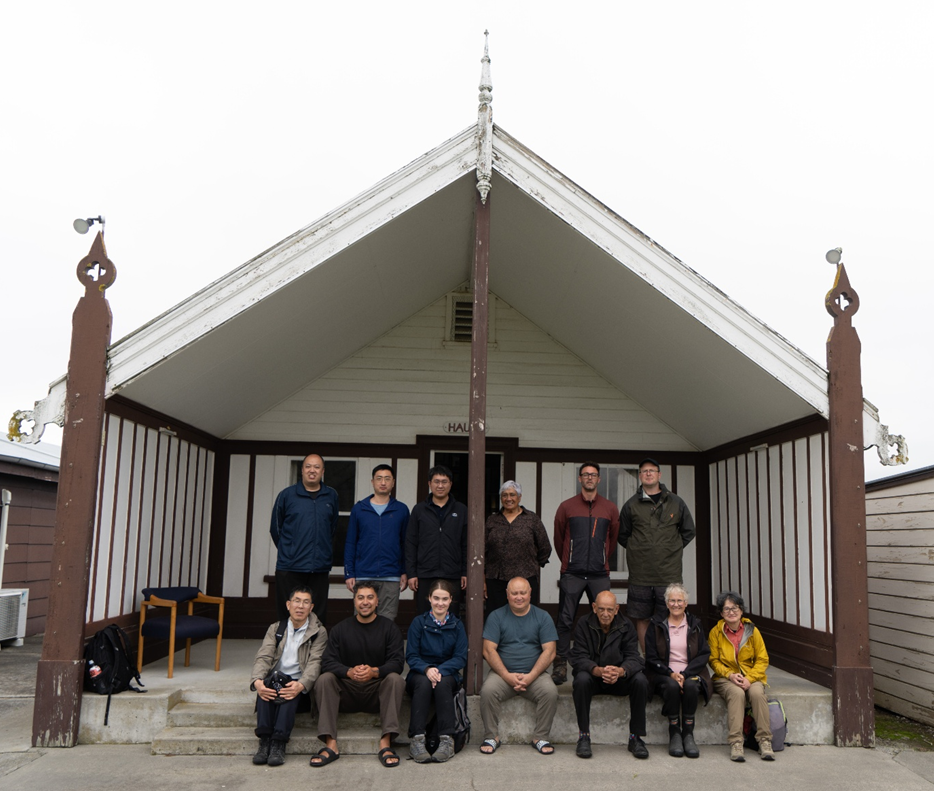
Field trip participants visiting Rātā Marae on 22 Jan 2026
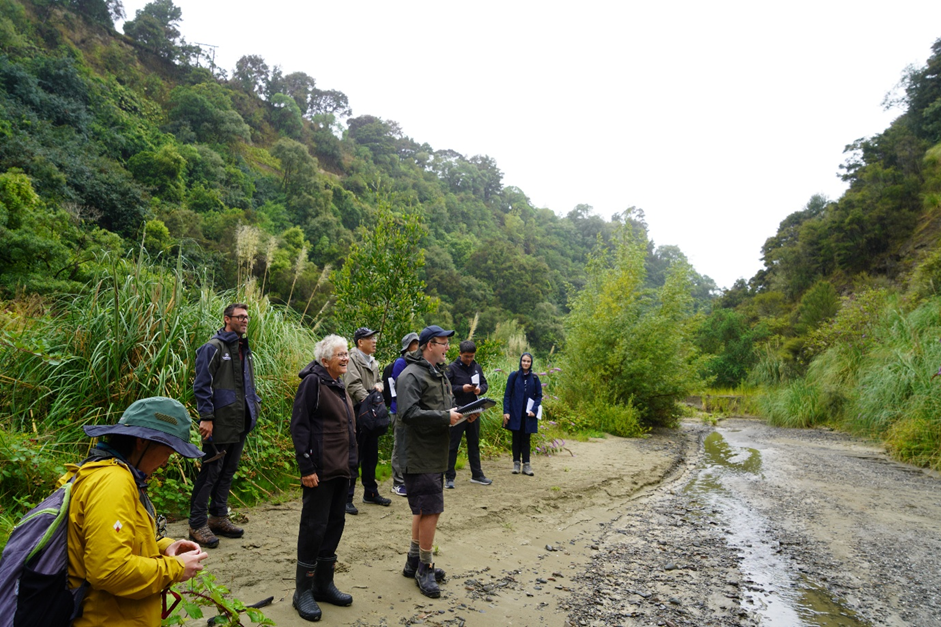
Callum Rees showcases the special geology at Waitapu Stream, where you can see the unconsolidated sandy deposits of the Kaimatira Pumice Sand Formation, which has failed at Pūtōrino to create the Pūtōrino Landslide.