Editorial
Welcome to the inaugural edition of NUTS NZ – the Newsletter for University Theatre Studies New Zealand.The purpose of the newsletter is to help us communicate more effectively as a community of scholars interested in Theatre and Performance. We hope this initiative will insure we are better able to support each other, collaborate together, and present a more united front in terms of important issues facing our discipline area in NZ. To insure we stay connected, NUTS NZ will provide updates on current research, seminars, events, and initiatives. Each newsletter issue will comprise stories, pictures, news items and potentially short interviews. NUTS NZ will focus specifically on theatre initiatives in New Zealand/Aotearoa. We will also have a segment in each newsletter in which we profile an academic AND a postgraduate student. This is a great opportunity to stay connected with “our” people and keep abreast of what one another are doing. In our first edition, we are pleased to be profiling Dr Laura Haughey and masters’ student Mihailo Ladjevac. In order to bring you the best updates in our area, we will be calling for submissions from each and every one of you. Thank you to all of you who have provided material for this edition and we look forward to working with you throughout the year to ensure this new initiative is a success.
NUTS NZ editors: Jane Marshall and Rand Hazou.
Below is a reminder of when our next issues will be “published” and the dates by which all relevant information is required.
Submissions for the following editions should be sent to the NUTS NZ editor Jane Marshall: j.g.marshall@massey.ac.nz
| Newsletter Issue |
Information Required by |
Date of Circulation |
| Issue 2 |
30 April 2014 |
16 May 2014 |
| Issue 3 |
31 July 2014 |
15 August 2014 |
| Issue 4 |
31 October 2014 |
30 November 2014 |
NUTS People
In each edition of NUTS NZ we will be profiling an academic and a post graduate student to show case “our people” and their current research/interests. It is our pleasure to be profiling Dr Laura Haughey – who is new to the University of Waikato – and Waikato post graduate student Mihailo Ladjevac in our first issue of NUTS NZ. As part of the profile, NUTS NZ asked each of them to answer the following questions: “What is your research about,” “What theatre/performances have you seen recently,” and “What have you been reading lately?”
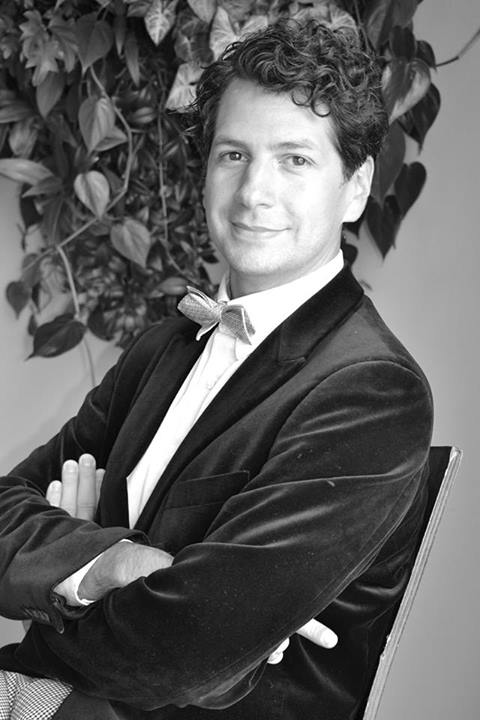
Dr. Laura Haughey – University of Waikato.

Laura trained as a physiotherapist who practised part time whilst touring and performing with a dance theatre company around the UK and Europe. She then undertook her MA in Physical Ensemble Theatre at the University of Huddersfield, where she went on to complete her PhD in ‘Practical Proprioception: An Examination of a Core Physiological Foundation for Physical Performance Training.’ Laura has worked professionally as a movement director, actor trainer, theatre director and workshop practitioner across the UK and in Europe and has taught at the University of Huddersfield, Edge Hill University and the University of Glamorgan.
- Research: psychophysical actor training, physical theatre, neuroscience and inclusive theatre practice.
- Theatre: The last theatre show I saw was Theatre AdInfinitum’s ‘Translunar Paradise’, a beautiful and delicately precise physical performance about bereavement, told entirely without words. It was an incredibly moving piece of theatre, and has toured internationally.
- Reading: I am currently immersed in Antonio Damasio’s ‘The Feeling Of What Happens: body, emotion and the making of consciousness’, as I develop my research into areas of neuroscience.
Mihailo Ladjevac – University of Waikato (Postgraduate Student)
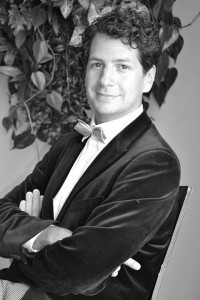
Mihailo Ladjevac is from Serbia Europe and has a Diploma in Acting from the Faculty of Dramatic Arts in Belgrade. He plays flute, piano, saxophone and speaks three languages; and has acted in television, film and TVCs. Since 2001Mihailo has been a full time actor with the National Theatre of Belgrade, in such productions as Don Quixote, Breakfast at Tiffany’s, Scenes from an Execution, Homebody/Kabul, The Glass Menagerie, Romeo and Juliet, Love’s Labour Lost, The Public Enemy, Ivanov, The Seagull, The Wedding, The Idiot, and Tartuffe. Mihailo’s awards include several Best Actor awards between 2005 and 2012.
- Research: For my research, I’ve picked a topic related to the biography and teaching method of Professor Bejcetic – my Acting lecturer. I believe his approach to students of acting is somewhat unique and universal. No matter where they come from, and what language they speak, I feel that Professor Bejcetic’s teaching technique brings the core of acting to the surface of every future actor; and I wanted to share this, for me, remarkable experience with people around me.
- Theatre: In the past six months I’ve seen a few performances, but I would like to highlight two. The most exciting to me was the New York Broadway musical Wicked at the Civic Theatre in Auckland and The History Boys, directed by Prof. Gaye Poole, at the Gallagher Academy of Performing Arts at the University of Waikato in Hamilton.
- Reading: At the moment, all my attention has been focused on the biographies of Chekhov, Eugenio Barba and Konstantin Sergeievich Stanislavski.
Performances
As part of each issue, NUTS NZ will give readers a “heads up” of the performances that are being produced throughout the year. There are some exciting performances being produced over the next few months across the campuses. Here is the line up from Massey and the University of Auckland:
The BITSA Performance Season:
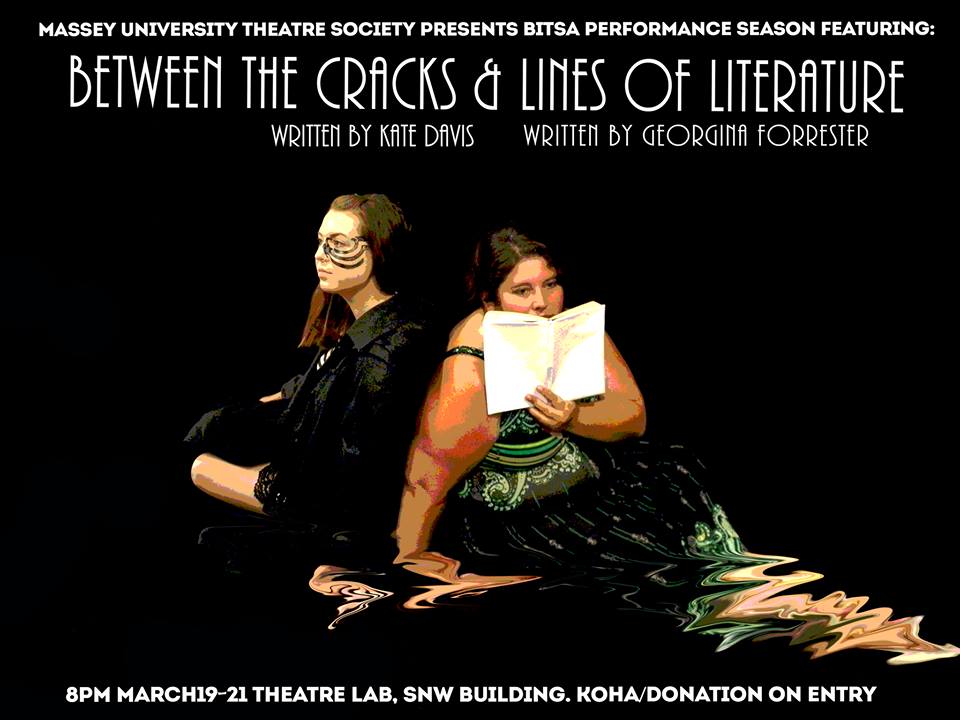
Massey University Theatre Society (MUTS) will be presenting a double-bill of two student plays as part of the BITSA performance season. Aspiring Albany student playwrights were invited to enter the inaugural playwriting competition last year. Named the Bitsas, the competition involves “Bits-A-Writing, Bits-A-Performing”. The two winning entries will be presented as part of a short season from Wednesday 19 to Friday 21st of March. The performances will be presented in the Theatre Lab at the Massey Albany campus. Doors open at 8pm. Entry is by Koha/Donation. For more information or to book tickets please email: masseyunimuts@gmail.com
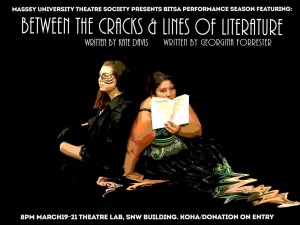
- ‘Between the Cracks’ by Kate Davis. Set on Auckland K’Rd, Between the Cracks is a play about an unlikely friendship between a sex worker and a middle-class woman. Written by Kate Davis, Massey student and former sex industry worker and regional coordinator in Auckland for the New Zealand Prostitutes’ Collective, the play provides an insider’s perspective to demystify the world of sex workers, and their diverse personalities, sexual identities and life stories. For more information click here.
- ‘Lines of Literature’ by Georgina Forrester. Lines of Literature is about a group of middle-aged Auckland woman who meet as part of book group. Written by Massey student Georgina Forrester, the play explores the lines between fiction and reality and how the women seem more invested in the ‘fiction’ of the romantic novels they read rather than in the ‘reality’ of their real lives, marriages, and businesses that seem to be crumbling around them.
University of Auckland Drama 2014 Productions:
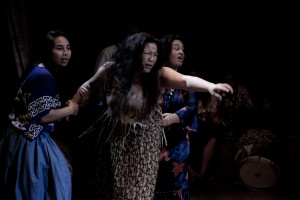
- That’s the Story, Morning Glory and Mockingbird. Thurs-Sun, 9, 10, 11, 12 October, in the Musgrove Studio, Maidment Theatre:
- That’s the Story, Morning Glory. Written and directed by Juliet Monaghan. On the edge of separating one minute, irresistibly drawn together the next, Johnny and Daisy have no choice but to ne- gotiate the cloudy waters of their eccentric pairing. That’s the Story, Morning Glory chronicles the lives of Johnny and Daisy as they discover new dimensions to the meaning of love.
- Mockingbird. Written and performed by Lisa Brickell. Directed by Ruth Dudding. With music by Sarah Macombee. Tina’s journey into the past is also a quest to find a new beginning. An original play about family secrets, about four genera- tions of women and about the unequivocal love we have for our children.
- The Wrong Way Kids. Written and directed by Russell King. Thurs-Sun, 16, 17, 18, 19 October in the Drama Studio, Arts 1 Building. Chase and Kelsey have run away from home. Fed up with their home lives, the two find themselves squatting in a derelict housing project, but life couldn’t be better. However, this all changes when their older brother, a small-time criminal tracks them down and invites himself to stay. A play about family, tough decisions, and what it really means to be a grown-up.
- Oh, What a Lovely War! by Joan Littlewood Directed by Alex Bonham and Performed by the Drama 204 class. Thurs-Sun, 18, 19, 20, 21 September in the Musgrove Studio, Maidment Theatre
- Songs, battles and a few jokes! This landmark production of 1964 celebrates the courage and endurance of the ordinary soldier, and sweeps away any lingering views that the First World War may have been ‘Great’. From the jingoistic recruitment drives of 1914 to the realities of trench life, the story of the conflict is told through the songs and entertainments of the time in an extraordinary piece of theatre that is both deeply moving and thoroughly entertaining.
- Endgame by Samuel Beckett Directed by Rina Kim. Performed by the Drama 710 class. Thurs-Sun, 22, 23, 24, 25 May in the Drama Studio, Arts 1 Building. Beckett wrote in his well-known letter to Alan Schneider who was directing the first production of Endgame in 1957: “My work is a matter of fun- damental sounds (no joke intended) made as fully as possible and I accept responsibility for nothing else. If people want to have headaches among the overtones, let them. And provide their own as- pirin.” Bearing this warning in mind and equipped with plenty of aspirin (no joke intended), Drama 710 class invites you to join their exploration of “fundamental sounds” in Endgame.
- Assorted Shorts: An evening of original short plays written, directed and performed by BA Hons students of Drama 730. Thurs-Sun, 7, 8, 9, 10 August in the Drama Studio, Arts 1 Building. Working as a class company, sharing the roles of writing, directing and performing, the students of Drama 730 present a collection of thematically connected short plays. Be prepared for a high-energy evening of fresh original theatre.
Bookings: Tickets can be reserved for all productions (except Oh, What a Lovely War!, That’s the Story, Morning Glory and Mockingbird) by telephoning the Drama Studio Ticket Line on: (09) 3737599 ext 84 226. Please leave a contact phone number when you book. Method of payment: CASH ONLY at the door at the time of performance. All reserved tickets should be collected 15 minutes prior to the start of the performance to guarantee admittance. The University may re-sell any tickets not collected by this time. Performances may be subject to change. Please contact the Ticket Line to confirm details. For Oh, What a Lovely War!, That’s the Story, Morning Glory and Mockingbird please book through the Maidment booking line (09) 308 2383. A transaction fee may apply when you book through this line.
New and Exciting
E(LAB)ORATING PERFORMANCE
In semester 1 2014, the Massey University Expressive Arts paper ‘139.220 Applied Theatre’ will be delivered as part of a transnational teaching and learning project entitled e(LAB)orating Performance. The project is an ongoing collaboration between Dr. Rand Hazou – Massey University (New Zealand), Nandita Dinesh – UWC Mahindra College (India), Sara Matchett – University of Cape Town (South Africa), and Nicola Cloete – University of the Witwatersrand (South Africa). The pilot project is funded by the Brown University International Advanced Research Institute (BIARI) on ‘Theatre and Civil Society’. The project seeks to facilitate creative engagements by students enrolled at participating institutions to foster conversations around performance praxis and collaborative pedagogies. As part of this project, Dr. Rand Hazou attended a curriculum development meeting in Pune, India in January. As a result, students enrolled in the paper 139.220 Applied Theatre will be encouraged to interact with students in India and South Africa. As part of a short creative exercise entitled ‘Performing the Self(ie)’ Massey students will be required to write a short monologue based on pictures or ‘selfies’ that students at UWC Mahindra College will provide. The task encourages students to respond creatively to ideas around performing racial and engendered identity and consider the status of a ‘picture’ as a document. The monologues that are created will then be ‘fed-back’ to students in India who will respond with short performances based on the texts. e(LAB)orating Performance will also give Massey students the opportunity to collaborate with youth in Cape Town, South Africa as part of the verbatim theatre group project. As part of this task, students will be given the opportunity to interview youth from the Langeberg Youth Arts Project in South Africa. The Langeberg Youth Arts Project is an initiative of The Mothertongue Project, an NGO co-founded by Sara Matchett who is one of the lead researchers on the e(LAB)orating Performance project. This exciting and ambitious project will help consolidate international networks in teaching and research and offer new opportunities for transnational collaboration. This a project that will potentially offer exciting new models of pedagogy and education delivery that will help foster transnational citizenship and engagement.
‘New Bachelor of Performing Arts Up and Running at the University of Otago’
The newly created Bachelor of Performing Arts (BPA) at The University of Otago has recently accepted its first intake of 22 students. This distinctive, exciting collaboration between the university’s programmes in Theatre, Music and Dance gives students a rare opportunity to study more than one performing art form – music, theatre and dance – within a single named specialist university degree. Students will be guided to develop their knowledge and skills in areas such as acting, dance, directing, devising, bicultural theatre, music performance (singing or instrument), composition, song-writing, technical production and the theoretical foundations of Theatre, Music and Dance. The BPA includes conservatoire training in classical or contemporary vocal or instrument and composition – previously only available to those undertaking the specialist Bachelor of Music. The degree is housed within the Department of Music and Theatre Studies and also offers teaching staff the opportunity to work across multiple disciplines. For any queries, please contact: Dr. Suzanne Little – Bachelor of Performing Arts Degree Programme Coordinator, University of Otago. Email: suzanne.little@otago.ac.nz
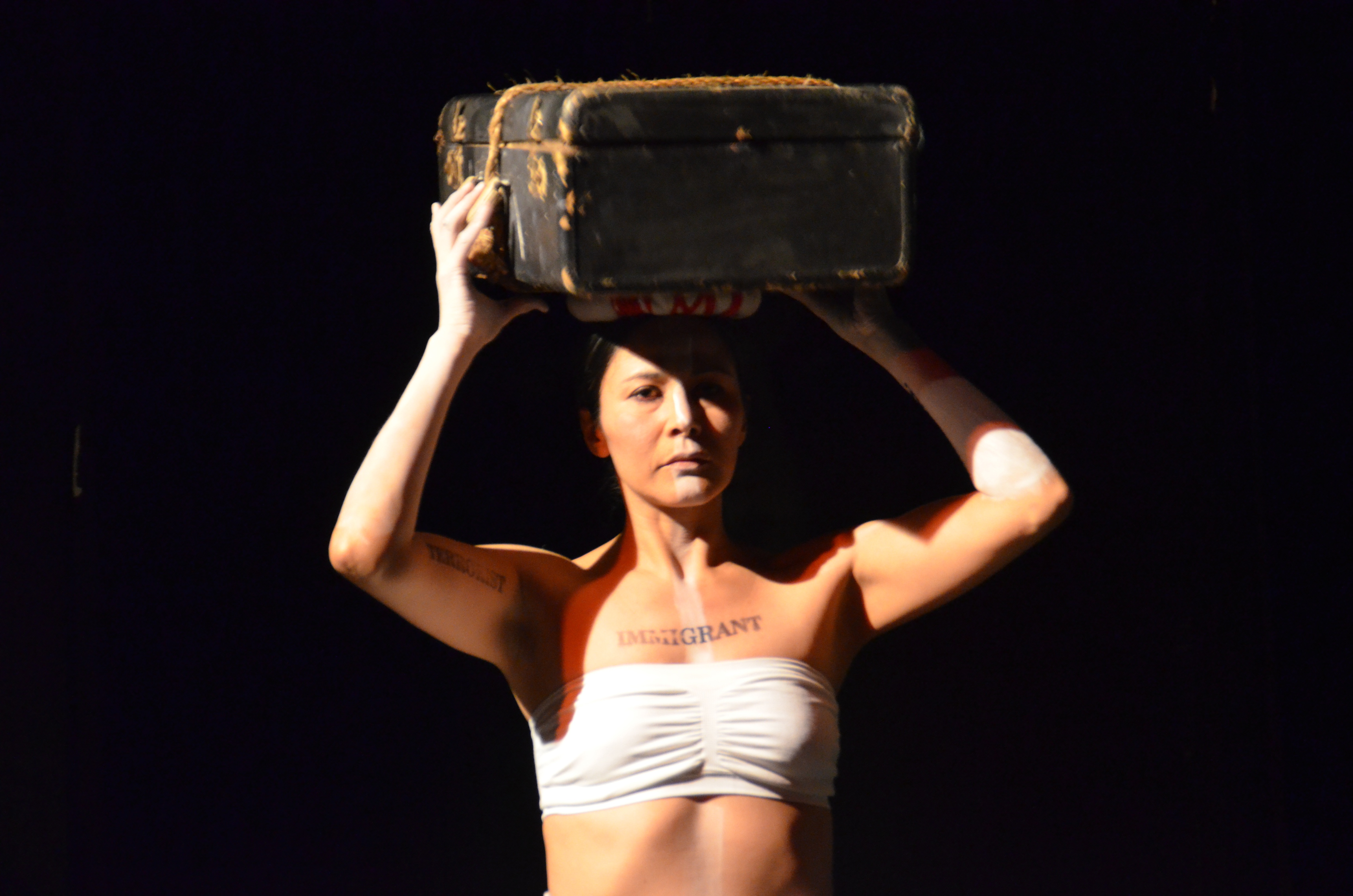
Workshop with international performance artist VIOLETA LUNA. The Body in Action: Paths Towards a Personal Cartography
This workshop has been created for artists of performance, dancers, actors, spoken word or visual artists interested in performance art and in exploring the intersection of the personal, the theatrical and the political through stage actions. Workshop participants will make use of their personal memory and identity as the expressive territory where they will chart a vocabulary of stage actions. Drawing on their use of body, participants will also work on imagery related to their individual and social understanding of gender, sexuality and race. Some thematic threads in the workshop include: Body (fiction and non-fiction, presence and inner strength, body as subject/object;) Space (internal and external, spatial relationships, the intervention of public and private space;) Time (real-time, fictional-time, ritual-time;) Action (site-specific, action – reaction, responses to real and imagined stimuli, audience interaction, the creative accident.)
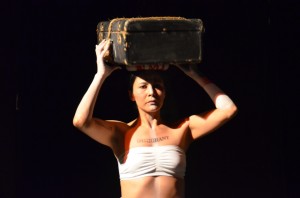
Photo: Nora Raggio
Who should apply: Professional or students of performance, spoken-word, actors, dancers and visual artists. All applicants should have a basic understanding of the discipline of performance art. Wellington, June 21-23, Massey University Wellington. Limited to 16 places. $150 per participant. To register interest, please Email Emma Willis: emmacreagh@gmail.com
Publications
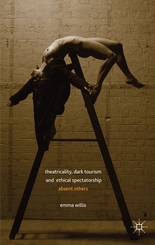
Theatricality, Dark Tourism and Ethical Spectatorship: Absent Others by Emma Willis
Palgrave Macmillan, 2014
About the book
Theatricality, Dark Tourism and Ethical Spectatorship: Absent Others builds upon recent literature concerning theatre and ethics and offers a uniquely interdisciplinary approach. With a focus on spectatorship, it brings together analysis of dark tourism – travel to sites of death and disaster – and theatrical performances. At dark tourism sites, objects and architecture are often personified, imagined to speak on behalf of absent victims. Spectators are drawn into this dialogical scenario in that they are asked to ‘hear’ the voices of the dead. Theatrical performances that depict grievous histories similarly gain power through paradoxically demonstrating the limits of their representational ability: spectators who must grapple with absences and incomprehensibilities. This study asks whether playing the part of the listener can be understood in ethical terms. Sites surveyed span a broad geographical scope – Germany, Poland, Vietnam, Cambodia, New Zealand and Rwanda – and are brought into contrast with performances including: Jerzy Grotowski’s Akropolis, Catherine Filloux’s Photographs from S21, Adrienne Kennedy’s An Evening with Dead Essex and Erik Ehn’s Maria Kizito.
Contents
Notes for the Traveller: An introduction to the Journey Ahead1. Landscapes of Aftermath2. Performing Museums and Memorial Bodies: Theatre in the Shadows of the Crematoria3. Vietnam: ‘Not the Bullshit Story in the Lonely Planet’4. Here was the place: (Re)Performing Khmer Rouge Archive of Violence5. Lost in our own Land: Reenacting colonial Violence6. The World Watched: Witnessing GenocidePhantom SpeakWorks Cited
Reviews
“Emma Willis’s worthy project, Theatricality, Dark Tourism and Ethical Spectatorship, places works for the theatre in dialogue with place-based memorials. Willis offers us practice-centered analysis for diverse objects of study. Following Willis as she takes on the challenges of these ethical/aesthetic encounters, readers will appreciate the book’s thorough research, sound argumentation, and elegant prose. An ambitious project effectively realized, this is insightful scholarship about a timely subject.” – Laurie Beth Clark, University of Wisconsin, USA
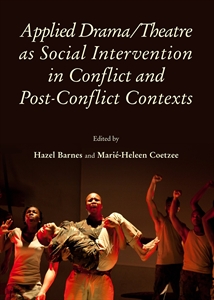
Applied Drama/Theatre as Social Intervention in Conflict and Post-Conflict Contexts edited by Hazel Barnes and Marié-Heleen Coetzee
Cambridge Scholars Publishing, 2014.
About the Book
This book explores the use of drama or theatre texts about, as approaches to, or methodologies for, interventions in conflict and post-conflict contexts. It maps the role of drama/theatre in the centre and in the aftermath of overt and direct conflict, traces how the relationship between drama/theatre and conflict is shaping the socio-cultural, political, and aesthetic landscapes of these contexts, and engages with drama/theatre as methodologies to address or forge new relationships around conflict. As such, it deals with the transformative abilities of drama/theatre in contexts where conflict or violence is overt or covert in its effects, expressions and modes of social control in a range of geographical constituencies. It includes chapters predominantly from South Africa, but also from rural Nigeria and New Zealand, reflecting work on conflict in prisons, tertiary and secondary education, cities, villages and families. It also contains two new original play scripts, both resulting in acclaimed performances: Hush, on family violence in New Zealand, and The Line, on xenophobia in South Africa.
Conferences/Scholarships/Prizes
CFP: ADSA Conference 2014 – Restoring Balance: Ecology, Sustainability, Performance, hosted by Victoria University of Wellington and Massey University, New Zealand, 25-28 June 2014.
The Australasian Association for Theatre, Drama and Performance Studies (ADSA) has issued a call for papers for the annual conference in June 2014. Confirmed Keynotes at the conference include Ric Knowles, Mexican performance artist Violeta Luna, and Baz Kershaw ( via virtual attendance). Please remember that a recurring highlight of the conference is the ‘New Zealand Delegates Dinner’ that provides NZ theatre scholars and practitioners a chance to meet, caucus and socialise. ADSA is also seeking nominations for ADSA prizes in 2014. ADSA recognises outstanding scholarship in different areas of theatre, drama and performance studies through the following awards:
- Marlis Thiersch Prize – for research excellence in an English-language article published anywhere in the world in the broad field of theatre and performance studies.
- Philip Parsons Prize – for a senior student (third year, honours or postgraduate) undertaking a performance as research project.
- Rob Jordan Prize – for the best book on a theatre, drama or performance studies related subject published in the previous two years.
- Veronica Kelly Prize – for the Best Postgraduate Paper presented at an ADSA conference.
- Geoffrey Milne Bursary – to assist two eligible postgradutes to attend each ADSA conference
Get your applications in for the prize now – or if you know someone who should be considered for a prize – please nominate them as soon as possible.
Upcoming Seminars
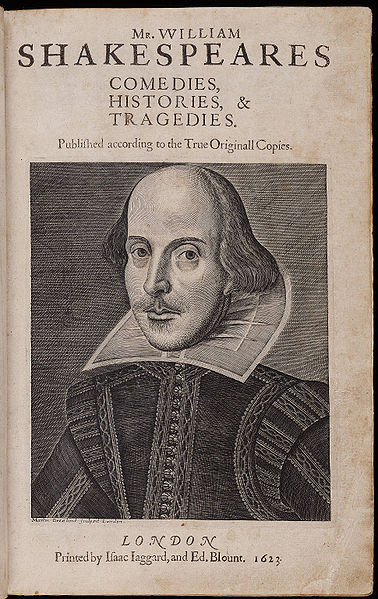
‘When Shakespeare Was New: Reading the 1623 Folio’ by Dr Emma Smith (University of Oxford) – Alice Griffin Shakespeare Fellow 2014.
Thursday 3 April, 6.30pm. Old Government House Lecture Theatre The University of Auckland
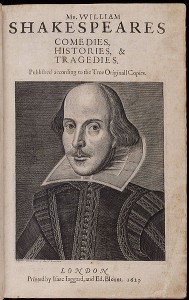
Early readers of Shakespeare encountered almost half of his works for the first time in the collected plays of 1623, the First Folio. The Tempest, Julius Caesar, Macbeth and Twelfth Night were among the plays first printed here. Dr Smith discusses how readers – actual and imagined – engaged with this ‘big book’ and its individual plays, using manuscript annotations and other evidence to understand what it was like to read these works in such a large format. Whereas most studies of the First Folio have been concerned with its production, this lecture looks at reception and about the way the book engages, and sometimes bewilders, its readers.
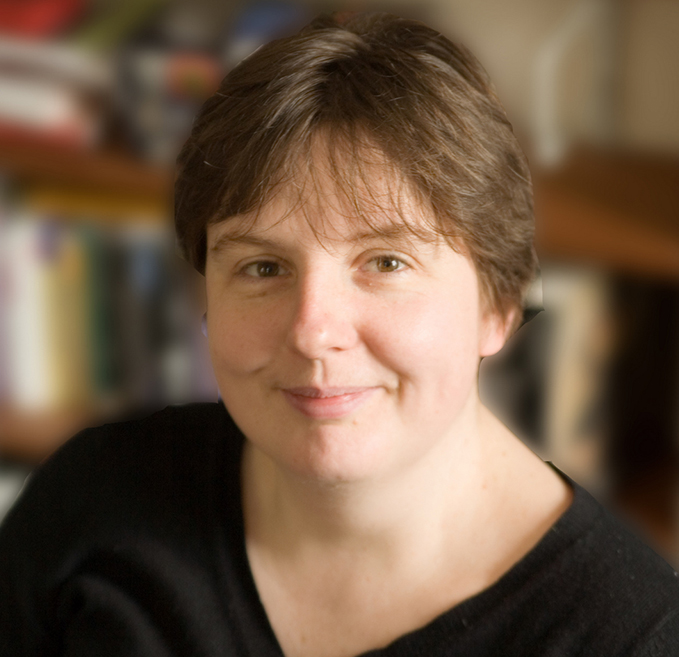
Dr Emma Smith (Hertford College, Oxford University)
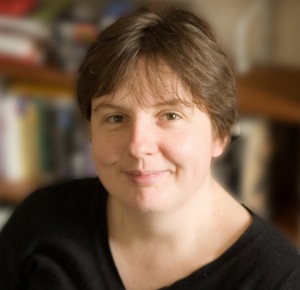
Dr Emma Smith (Hertford College, Oxford University) is the author of The Cambridge Introduction to Shakespeare, of a series of Guides to Criticism of Shakespeare’s plays, and of 30 Great Myths About Shakespeare as well as of numerous scholarly articles on topics such as “Hamlet and Consumer Culture” and “Was Shylock Jewish?”. She is currently Lecturer in Renaissance Literature at Oxford University and is a regular podcaster on Shakespeare.